
Neck & Cervical Pain
Understanding Neck Pain —
Finding the Source
Neck pain rarely originates where you feel it most. ROOT METHOD traces every cervical symptom — localised stiffness, radiating arm pain, and cervicogenic headache — back to its structural or neurological origin in the cervical spine.
Clinical Overview
What is Neck Pain?
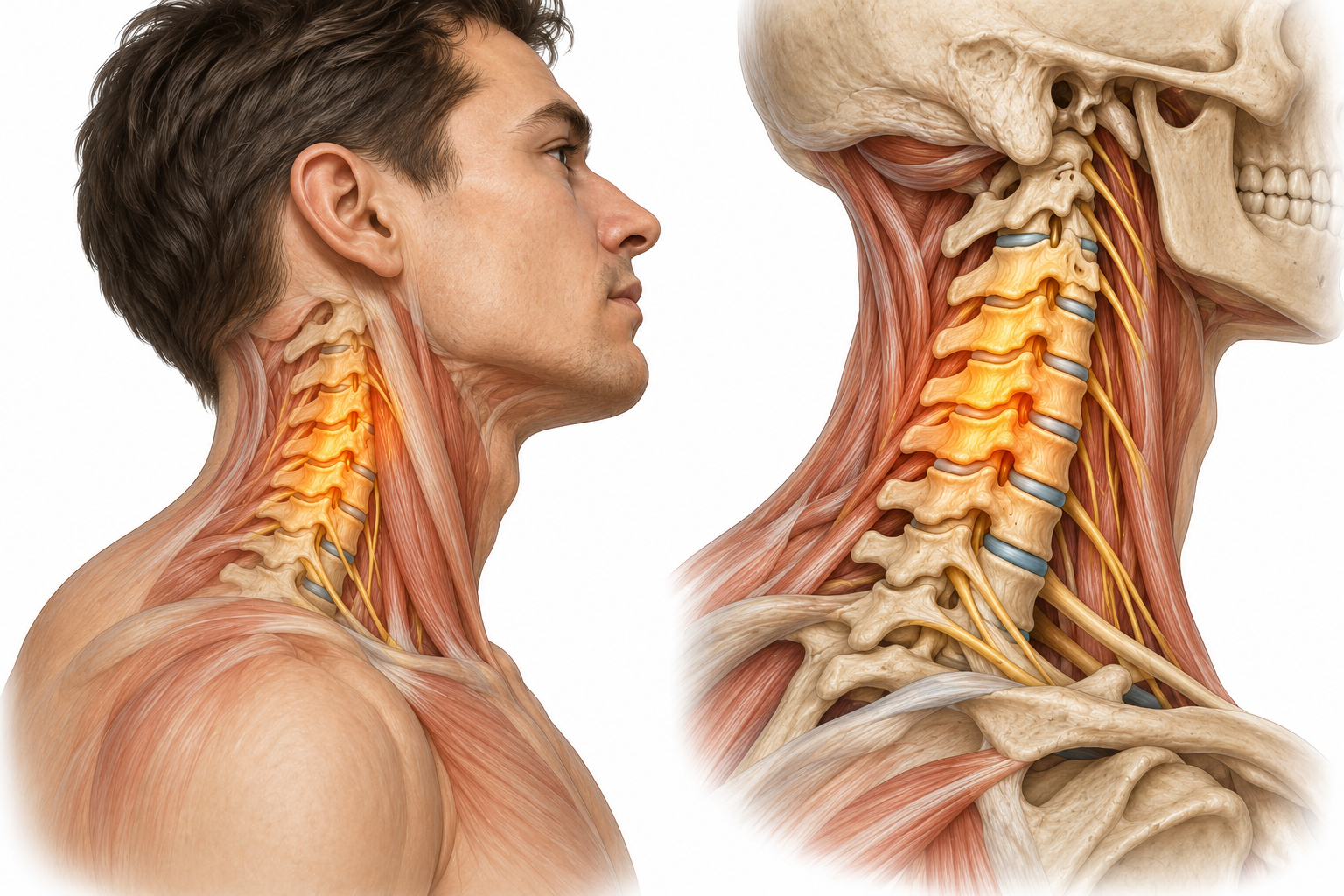
The cervical spine is one of the most mechanically complex and neurologically dense regions of the body. Seven vertebrae — C1 through C7 — support the full weight of the head while allowing multidirectional movement across a broader range of motion than any other spinal region. Eight cervical nerve roots supply the shoulders, arms, and hands. The spinal cord passes through the cervical canal. And all of this is compressed into a structure roughly the same width as your palm.
Neck pain is a symptom, not a diagnosis. It can originate from the intervertebral disc, the facet joints, the nerve roots, the surrounding musculature, or the ligaments — and the symptoms it produces are not confined to the neck itself. When cervical nerve roots are compressed or irritated, pain, numbness, and weakness travel into the shoulder, arm, and hand. When the spinal cord is affected, symptoms can extend further still.
Acute neck pain typically follows a specific event — a road traffic accident, a sudden twisting movement, or an awkward sleeping position. Chronic neck pain persists beyond 12 weeks and is more commonly the product of accumulated disc degeneration, postural loading, or an unresolved structural problem from an earlier injury that was never fully investigated.
Clinical Presentation
Common Symptoms of Neck Pain
Cervical symptoms frequently extend well beyond the neck. Understanding the full pattern — including symptoms in the head, shoulder, and arm — is essential to identifying the origin.
Localised Neck Pain
Pain, aching, or stiffness confined to the neck — most commonly at the base of the skull, the mid-cervical region, or the lower cervical spine at its junction with the thoracic region. The location, character, and pattern of localised neck pain carry diagnostic significance in identifying the affected structure.
Cervicogenic Headache
Pain originating in the cervical spine and referred into the head — commonly felt at the base of the skull, behind the eyes, or at the temple. Cervicogenic headache is frequently misdiagnosed as tension headache or migraine, and is treated symptomatically for years without the underlying cervical origin being investigated.
Arm and Shoulder Pain
Pain radiating from the neck into the shoulder, upper arm, forearm, or hand — a pattern known as cervical radiculopathy. This indicates irritation or compression of a specific cervical nerve root. The distribution of the arm pain and any associated neurological symptoms identify the affected spinal level precisely.
Restricted Movement
Reduced range of motion in rotation, lateral flexion, or extension — often with pain at the end of available range. Movement restriction may reflect facet joint dysfunction, protective muscle guarding around an irritated structure, or structural narrowing of the neural foramina that becomes symptomatic as range is approached.
Neurological Symptoms
Numbness, tingling, pins and needles, or weakness in the arm, forearm, or hand. These symptoms indicate nerve root irritation or compression at a specific cervical level. The exact distribution — which fingers are affected, which movements are weak — identifies the responsible segment with clinical precision.
Balance and Coordination Changes
Dizziness, unsteadiness, or changes in coordination can arise when the cervical spine affects vertebral artery flow, cervical proprioception, or — in more serious presentations — the spinal cord itself. These symptoms are distinct from inner ear causes and require careful clinical differentiation before any treatment is undertaken.
Clinical Aetiology
Common Causes of Neck Pain
The cervical spine's complexity means that multiple structures can contribute to the same symptom picture. Identifying the primary driver is the first clinical challenge — and the one most often skipped.
Cervical Disc Pathology
Disc herniation, bulge, or degeneration at any cervical level can compress adjacent nerve roots or the spinal cord itself. Cervical disc pathology is one of the most common causes of both neck pain and arm symptoms, with the levels C5/C6 and C6/C7 most frequently involved. The pattern of arm symptoms identifies the affected level.
Cervical Radiculopathy
Compression or chemical irritation of a cervical nerve root — from a disc herniation, osteophyte formation, or foraminal narrowing — produces a predictable pattern of pain, numbness, and weakness extending into the arm and hand. Mapping the exact dermatomal and myotomal distribution of symptoms identifies the responsible cervical level before any imaging is required.
Facet Joint Dysfunction
The cervical facet joints guide movement and bear load with every head rotation. Degeneration, acute locking, or capsular irritation produces a deep, unilateral neck ache that is often associated with restricted rotation and referral into the head, shoulder, or upper arm. Facet-mediated pain is commonly attributed to disc pathology when the facet is the true driver.
Whiplash and Acceleration Injury
Rapid acceleration-deceleration of the cervical spine — most commonly in road traffic accidents — can simultaneously injure multiple structures: discs, facet joint capsules, ligaments, and surrounding musculature. The clinical picture is often complex and evolves over days to weeks after the event. Whiplash that is not fully assessed often becomes chronic pain with an unidentified structural basis.
Cervical Myelopathy
Compression of the spinal cord within the cervical canal — from a herniated disc, osteophyte formation, or thickened ligamentum flavum — produces symptoms that extend well beyond neck pain: hand clumsiness, arm weakness, gait disturbance, and balance difficulties. Myelopathy is a serious condition that requires clinical recognition and appropriate onward referral.
Postural and Occupational Dysfunction
Forward head posture during sustained screen use, prolonged desk work, or repetitive neck movements place cumulative mechanical load on cervical structures — particularly the discs and facet joints of the lower cervical spine. This gradual loading produces degenerative change and muscular imbalance that develops without a single identifiable onset event.
Clinical Guidance
When to Seek Professional Assessment
Knowing when neck pain requires clinical assessment — and when it requires urgent attention — is the first step towards getting the right care.
Book a Clinical Assessment If…
- Neck pain has persisted for more than 4 weeks without meaningful improvement
- Pain radiates into the shoulder, arm, or hand
- You experience recurrent headaches originating from the base of the skull
- Restricted head rotation is significantly limiting daily activity or driving
- Symptoms began following a road traffic accident or whiplash injury
- Physiotherapy or prior treatment has not produced lasting improvement
Seek Emergency Care Immediately If…
- You develop progressive weakness or clumsiness in both arms or legs — this may indicate spinal cord compression
- Neck pain after significant trauma is accompanied by any neurological symptoms in the arms or legs
- You experience sudden onset of severe dizziness, loss of balance, or difficulty swallowing alongside neck pain
- Arm or hand weakness develops rapidly over hours to days without preceding neck pain
- You have difficulty walking or notice changes in bladder or bowel control alongside neck symptoms
The ROOT METHOD Difference
How ROOT METHOD Approaches Neck Pain
Cervical pain is challenging to diagnose because so many structures can produce similar symptoms. A disc at C5/C6, a facet joint at C4/C5, or a muscle in protective spasm around an irritated nerve can all present as "neck pain with shoulder aching." The intervention required for each is entirely different.
ROOT METHOD approaches each patient's cervical presentation as a structured clinical investigation. Before any treatment decision is made, the assessment works to establish:
- Which cervical structure is the primary pain generator — disc, facet joint, or nerve root?
- Is there nerve root involvement, and at which specific cervical level?
- Is cervicogenic headache arising from a specific segmental source?
- Are there any clinical signs suggesting spinal cord involvement that require onward referral?
- What postural, occupational, or biomechanical factors are sustaining the problem?
Your First Visit
What to Expect During Your Neck Pain Assessment
A ROOT METHOD cervical assessment is a 90-minute clinical appointment. Here is what happens at each stage.
-
Before You Arrive
Pre-Visit Intake Form
You will complete the ROOT METHOD 8-step intake form before your appointment. For cervical presentations, this captures the onset and duration of neck symptoms, the pattern and distribution of any arm or head symptoms, prior treatments, medication, and how your symptoms vary with posture and position. This information allows Dr. Umer to begin clinical reasoning before the examination starts.
-
Stage 1
Postural and Cervical Movement Assessment
Dr. Umer assesses your posture — head position, shoulder alignment, and thoracic curvature — and measures cervical range of motion in all planes: flexion, extension, lateral flexion, and rotation. The movement that most reliably reproduces your pain is identified. Upper limb tension tests screen for nerve root sensitisation and help establish which cervical levels are involved before segmental examination.
-
Stage 2
Neurological and Segmental Examination
Dermatomal sensation, upper limb reflexes, and myotomal muscle strength testing identify any nerve root compromise and the responsible cervical level. Palpation of each cervical segment identifies localised tenderness, tissue changes, and joint restriction. Where appropriate, screening for cervical myelopathy and vertebrobasilar considerations is included as part of the standard examination protocol.
-
Stage 3
Diagnosis and Protocol Discussion
Dr. Umer reviews all examination findings with you, explains the clinical reasoning in plain language, and provides a specific diagnosis or structured differential where multiple factors are contributing. The proposed treatment protocol is explained, including which structures are being targeted and why. You leave the appointment with a clear understanding of what is driving your neck pain and a personalised plan for addressing it at source.

Common Questions
Questions About Neck Pain and ROOT METHOD
Can neck pain cause headaches?
Yes — and this connection is more common than is generally recognised. Cervicogenic headache is a distinct clinical entity in which pain originates from the cervical spine and is referred into the head. The upper cervical segments (C1 to C3) refer pain into the base of the skull, the back of the head, and the temple. The mechanism is well-established: the trigeminal and upper cervical nerve pathways converge at a shared nucleus in the brainstem, which means that cervical input can produce head pain.
Cervicogenic headache is frequently mistaken for tension headache or migraine and treated symptomatically — often for years — without the cervical origin being investigated. ROOT METHOD specifically assesses whether your headaches have a cervical component and, if so, which segment is the primary driver.
What is cervical radiculopathy and how is it assessed?
Cervical radiculopathy is the clinical term for pain, numbness, tingling, or weakness arising from the compression or irritation of a cervical nerve root. The symptoms follow a predictable dermatomal and myotomal pattern depending on which root is involved. C5 compression typically produces lateral shoulder and upper arm symptoms. C6 affects the thumb and index finger. C7 affects the middle finger and triceps. C8 affects the ring and little finger.
ROOT METHOD uses clinical examination — upper limb tension tests, dermatomal sensation mapping, reflex testing, and myotomal muscle strength assessment — to identify the affected level before any imaging is ordered. Imaging is then directed at the specific level identified clinically, which significantly improves the diagnostic yield of MRI and avoids the confusion caused by incidental findings at other levels.
Do I need an MRI before my assessment?
No. Clinical examination can often identify the affected cervical level and the likely responsible structure before imaging is undertaken. MRI of the cervical spine frequently shows degenerative changes — including disc bulges and foraminal narrowing — at multiple levels, and these findings are common in people without symptoms. Without a clinical examination to determine which level corresponds to the patient's actual symptom pattern, MRI findings can be misleading.
If you have existing MRI reports or clinic letters, please bring them. Dr. Umer will review them in the context of the clinical examination findings. If additional imaging is required, it will be requested with a specific clinical question directed at the level identified during the assessment.
I have had neck pain since a car accident. How does ROOT METHOD approach whiplash?
Whiplash-associated disorder is one of the most complex cervical presentations precisely because multiple structures may be injured simultaneously — and because the initial management at the time of the accident often focuses on symptom relief rather than structural investigation. Many patients develop chronic neck pain following a whiplash injury that was never fully assessed for its structural component.
ROOT METHOD examines whiplash presentations systematically: identifying which structures were most likely injured based on the mechanism, the symptom pattern, and examination findings; determining whether disc, facet joint, or neurological involvement is present; and designing a protocol that addresses the specific structural findings rather than managing pain non-specifically.
What is cervical myelopathy, and should I be concerned?
Cervical myelopathy is compression of the spinal cord within the cervical canal. Unlike radiculopathy — which compresses individual nerve roots — myelopathy affects the cord itself, producing symptoms that can extend well beyond the neck and arms: difficulty with fine hand movements, gait disturbance, balance problems, and in advanced cases, bladder dysfunction.
Myelopathy can develop gradually and is sometimes initially dismissed as general weakness or age-related change. If clinical examination reveals signs of spinal cord involvement, ROOT METHOD will identify this and refer appropriately — typically for urgent neurosurgical evaluation. The assessment protocol includes specific myelopathy screening as a standard component of every cervical examination.
I spend long hours at a desk. Can this cause the type of neck pain ROOT METHOD addresses?
Yes — occupational neck pain from sustained postures is a genuine structural problem, not simply muscular fatigue. Forward head posture places significantly increased mechanical load on cervical discs and facet joints. For every centimetre the head moves forward from its neutral position, the effective load on the lower cervical spine increases substantially. Over months and years, this cumulative mechanical stress produces disc degeneration, facet joint inflammation, and muscular imbalance.
ROOT METHOD assesses occupational neck pain by identifying which structures have been most affected by the loading pattern, and by incorporating postural and biomechanical correction into the treatment protocol — rather than treating only the pain while leaving the causative load pattern unchanged.
Neck Pain Has a Source. We Find It.
Most patients with persistent neck pain — including those with arm symptoms, headaches, or neurological changes — have never received a complete clinical investigation of the cervical spine. ROOT METHOD provides that investigation, and a treatment plan directed at what is actually driving your pain.