
Sports Injuries
Understanding Sports Injuries —
Finding the Source
Sports injuries span tendons, ligaments, muscles, cartilage, and bone — each tissue requires a different loading strategy during recovery. The correct treatment depends entirely on the correct structural diagnosis. ROOT METHOD identifies which structure is injured before prescribing how to rehabilitate it.
Clinical Overview
What are Sports Injuries?
Sports injuries are musculoskeletal injuries that arise through physical activity — either acutely (from a single traumatic event) or insidiously (from cumulative load over time). Acute injuries include ligament sprains, muscle strains, tendon avulsions, joint dislocations, and bone fractures. Overuse injuries — which account for approximately 50% of all sports injuries in competitive athletes — include tendinopathies, stress fractures, apophysitis in adolescents, and repetitive overload of cartilaginous and bony structures. Each tissue type has a specific biological healing timeline and a specific loading tolerance that determines the rehabilitation approach.
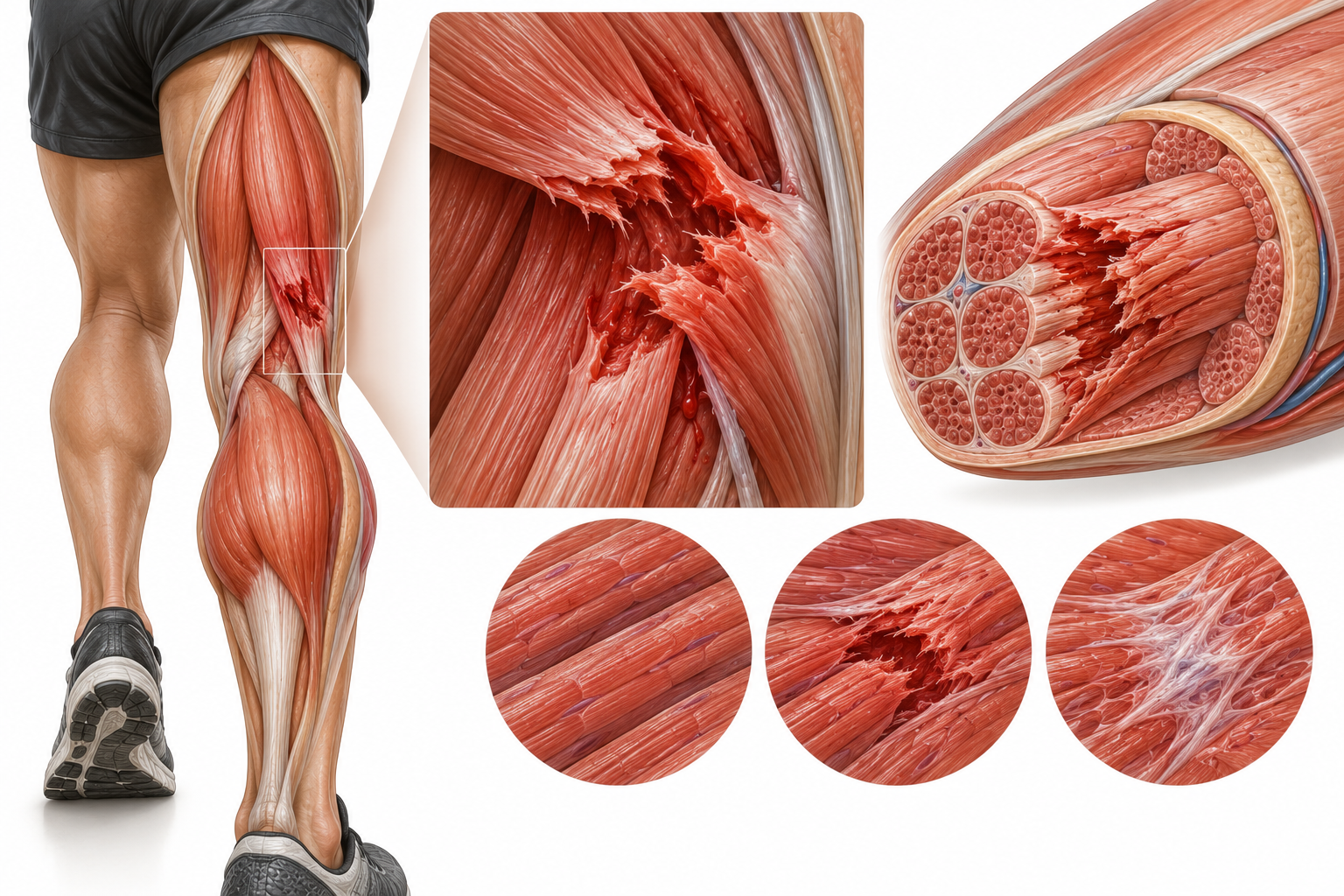
The foundational clinical error in sports injury management is prescribing treatment based on a generic label rather than a tissue-specific diagnosis. A patient labelled 'hamstring injury' could have a proximal tendon avulsion, a mid-belly muscle tear, a distal musculotendinous junction strain, or a sciatic nerve injury with hamstring-region symptoms — and each of these requires a fundamentally different management approach. Similarly, knee pain in a runner could be patellar tendinopathy, iliotibial band syndrome, meniscal pathology, or fat pad impingement — conditions with opposing responses to specific rehabilitation exercises.
ROOT METHOD applies the principles of tissue-specific diagnosis to sports injuries: identifying the exact structure injured, grading the severity, understanding the loading history that led to the injury, and designing a progressive rehabilitation protocol that respects the biological healing timeline while optimising return-to-sport readiness. The goal is not simply pain relief — it is restoration of full structural integrity and neuromuscular function to the level required for the patient's specific sport and training demands.
Clinical Presentation
Common Presentations of Sports Injuries
The onset mechanism, pain character, and functional limitations each provide critical information for identifying the specific tissue involved and the severity of injury.
Acute Onset with Clear Mechanism
Sudden-onset pain following a specific traumatic event — a fall, tackle, awkward landing, or sudden direction change. Acute injuries produce immediate pain, swelling, and functional limitation at the time of injury. The mechanism of injury (the direction of force, the activity, and the position of the body) directly points to which structures are at risk — inversion mechanism injures lateral ankle ligaments; hyperextension of the knee injures the ACL; shoulder fall injures the acromioclavicular joint.
Gradual Onset with Training Load Changes
Insidious pain that develops over days to weeks — typically following a sudden increase in training volume, intensity, or surface change. This pattern is the hallmark of overuse injuries: tendinopathies, stress fractures, and repetitive soft tissue overload. The pain is initially mild during activity and resolves with rest, before progressively worsening and beginning to appear at rest or during daily activities as the tissue's load tolerance is increasingly exceeded.
Pain that Warms Up but Returns
A pain pattern specific to tendinopathy: stiffness and pain at the start of activity that temporarily improves after 10–15 minutes of warm-up, before returning as exercise continues or after activity concludes. This 'warm-up then deterioration' pattern reflects the biomechanical properties of degenerative tendon tissue — it tolerates initial loading but loses its shock-absorbing capacity with sustained or high-intensity load, distinguishing it from ligamentous and muscular injury patterns.
Sudden Snap or Pop with Immediate Weakness
A felt or audible 'pop' or 'snap' at the moment of injury — followed by immediate joint instability, swelling, and inability to perform the activity — is characteristic of complete ligament rupture, tendon rupture, or grade III muscle tear. The Achilles tendon rupture produces a characteristic felt 'kick' in the back of the leg during a sprint or jump. ACL rupture produces an audible pop and immediate knee instability with haemarthrosis. These injuries require urgent clinical assessment.
Localised Bony Tenderness with Increasing Pain
Point tenderness directly over a bony structure — metatarsal, tibia, femoral neck, calcaneus — that worsens progressively over days to weeks of continuing activity suggests a stress fracture. Stress fractures are trabecular bone microfractures from cumulative cyclical load. They do not initially show on plain X-ray, requiring MRI or bone scan for early detection. Continued loading through an undiagnosed stress fracture risks complete cortical fracture and a significantly extended recovery.
Persistent Recurrent Injury in the Same Location
A pattern of recurring injury to the same structure — the same hamstring, the same calf, the same groin — despite apparent recovery between episodes signals that the underlying cause of the injury has not been identified or addressed. Recurrent sports injuries almost always reflect an unresolved biomechanical driver: inadequate hip extension power loading the hamstrings, reduced ankle dorsiflexion loading the calf, or hip abductor weakness predisposing to lateral knee overload. Identifying and addressing the driver is the only path to breaking the cycle.
Clinical Aetiology
Common Causes of Sports Injuries
Sports injuries arise from acute traumatic mechanisms or cumulative training overload — both requiring tissue-specific assessment to determine the correct management approach.
Tendinopathy from Overuse
Degenerative change in tendon structure from sustained or sudden overloading — the most common overuse injury in sport. Affects the Achilles, patellar, rotator cuff, common extensor (tennis elbow), gluteal, and hamstring tendons most frequently. Tendinopathy is not inflammatory in the classical sense — it reflects failed healing with disorganised collagen and neovascularisation, and is managed with specific progressive loading protocols (not rest or anti-inflammatory medication).
Ligament Sprain from Traumatic Mechanism
Acute ligament injury from a single forceful event beyond the ligament's tensile strength — ranging from grade I (stretch) to grade III (complete rupture). Common in contact sports, field sports, and court sports with rapid direction changes. The clinical severity of the sprain determines the management pathway: grade I and II injuries are managed conservatively; grade III injuries require assessment for functional instability and surgical candidacy.
Muscle Strain from Rapid Loading
Acute muscle fibre tearing from a sudden eccentric contraction — the hamstring during sprinting, the calf during push-off acceleration, the adductor during lateral movement — producing immediate pain, localised tenderness, swelling, and loss of strength at the muscle-tendon junction or muscle belly. Graded from I (minor fibre tear) to III (complete rupture). Inadequate initial management and premature return to full loading are the main causes of reinjury.
Stress Fracture from Cumulative Impact
Trabecular bone fatigue fractures from repetitive cyclical loading that exceeds the bone's adaptive capacity — particularly following rapid training volume increases, return from injury, or dietary inadequacy. Common sites are the metatarsals, tibia, fibula, femoral neck, and lumbar pars interarticularis. Femoral neck stress fractures carry particular risk and require urgent offloading. Early identification through clinical suspicion and MRI prevents progression to complete cortical fracture.
Training Load Error
The single most common preventable factor in sports injury — a sudden, excessive increase in training volume (weekly kilometres), intensity (speed sessions or heavy weights), or frequency without adequate recovery. The 10% rule (increasing weekly load by no more than 10%) provides a general framework, but the appropriate progression rate depends on the individual athlete's tissue capacity, training history, recovery quality, and injury history. Load monitoring and progressive programming are core components of ROOT METHOD's sports injury management and prevention approach.
Biomechanical Predisposition
Underlying movement patterns, muscle imbalances, or alignment factors that increase the load on a specific structure during sport — making that structure vulnerable to either acute or overuse injury. Hip abductor weakness increasing knee valgus and patellar tendon load; reduced ankle dorsiflexion shifting load to the plantar fascia; poor trunk control increasing lumbar spine exposure during rotational sport. Identifying and correcting these factors is essential for breaking the cycle of recurrent sports injury.
Clinical Guidance
When to Seek Professional Assessment
Not all sports injuries can be self-managed. Clinical assessment identifies the specific tissue injured and determines the appropriate management — including when imaging is essential.
Book a Clinical Assessment If…
- An injury has not followed the expected recovery trajectory for a minor strain or sprain
- You have experienced a recurrent injury in the same structure — suggesting the underlying driver has not been identified
- Pain is producing a change in your movement pattern or sport technique — indicating significant functional compromise
- You need an evidence-based return-to-sport protocol with objective milestones rather than a time-based approach
- Gradual-onset pain is worsening progressively over weeks despite activity modification — possible stress fracture or tendinopathy
- You are preparing for a competitive event and need an injury risk assessment and optimisation plan
Seek Urgent Assessment If…
- An audible pop or felt 'snap' during activity with immediate joint instability — possible ligament or tendon rupture requiring urgent assessment
- Inability to weight-bear after lower-limb injury with bony tenderness — possible fracture requiring X-ray urgently
- Groin or hip pain in a runner that is worsening despite offloading — possible femoral neck stress fracture, a high-risk injury requiring immediate imaging
- Acute knee haemarthrosis — a bloody, tense knee joint following an injury requires urgent assessment for ACL rupture and possible meniscal damage
- Suspected concussion — any head impact during sport with confusion, headache, or amnesia requires immediate removal from play and medical assessment
The ROOT METHOD Difference
How ROOT METHOD Approaches Sports Injuries
Generic sports injury management — rest, ice, and return to sport when pain settles — is a framework that works for minor grade I injuries but fails to address the specific structural, biomechanical, and load management requirements of higher-grade injuries, overuse injuries, and recurrent injury patterns. The consequence is prolonged recovery, reinjury, and — in the case of missed stress fractures — complete cortical fracture.
ROOT METHOD applies a tissue-specific framework to sports injury:
- Tissue identification — determining whether the injured structure is tendon, ligament, muscle, cartilage, bone, or nerve, as each has a distinct biological healing profile and loading requirement
- Severity grading — quantifying the degree of structural disruption to determine the initial load tolerance and timeline for return to sport
- Biomechanical driver assessment — identifying the movement patterns, muscle imbalances, or training load errors that contributed to the injury
- Imaging decision — determining when and what type of imaging is clinically required to confirm or exclude high-risk pathology
- Progressive loading protocol — prescribing a specific, staged rehabilitation programme with objective return-to-sport criteria
- Prevention planning — addressing the identified drivers to reduce the risk of recurrence
Your First Visit
What to Expect During Your Sports Injury Assessment
ROOT METHOD's sports injury assessment is designed to identify the specific tissue injured, the biomechanical contributors, and the most effective rehabilitation and return-to-sport pathway for your specific activity demands.
-
Before You Arrive
Pre-Visit Sports Intake Form
You complete the ROOT METHOD sports intake form covering your training history, sport and position, the mechanism and location of injury, pain pattern (acute vs. gradual, warming up vs. worsening with activity), and any prior management. Your sport-specific demands inform the return-to-sport targets throughout the rehabilitation process.
-
Stage 1
Tissue Identification and Severity Grading
Clinical examination identifies whether the pain generator is tendon, ligament, muscle, cartilage, bone, or nerve through targeted provocation testing, palpation, and strength assessment. The severity of structural involvement is graded. Where imaging is clinically indicated — stress fracture suspected, complete rupture to be confirmed, osteochondral damage possible — a specific imaging request is formulated.
-
Stage 2
Biomechanical Driver Assessment
Movement analysis and targeted strength testing identify the specific biomechanical contributors — the muscle imbalances, ROM restrictions, or movement pattern deficits — that loaded the injured structure beyond its tolerance. Training load history is reviewed to identify progressive overload errors. These findings determine both the rehabilitation protocol and the preventive component of the management plan.
-
Stage 3
Progressive Rehabilitation Protocol
Dr. Umer provides a staged rehabilitation protocol with objective return-to-sport criteria — not time-based milestones. The protocol specifies the initial load (type, intensity, frequency), the progression criteria, the sport-specific preparation phase, and the return-to-play tests. Biomechanical driver correction is embedded throughout the protocol to prevent recurrence.
Common Questions
Questions About Sports Injuries and ROOT METHOD
Should I rest completely when I have a sports injury?
Complete rest is rarely the optimal response to a sports injury and can actually delay recovery for many tissue types. Tendons, muscles, and ligaments all require mechanical loading to stimulate the collagen remodelling that restores structural integrity — zero load during the healing phase leads to tissue deconditioning and can extend the overall recovery timeline. The appropriate response is relative rest: reducing the provocative activity while introducing controlled, tissue-appropriate loading at the correct intensity.
The exception is stress fractures, which require offloading to allow the trabecular bone fracture to heal before progressive loading is reintroduced. For muscle strains, complete rest for the first 24–48 hours is appropriate to allow initial haemostasis, but gentle progressive loading should begin within 48–72 hours guided by pain response. For tendinopathies, the evidence strongly supports continued loading through a specific progressive exercise protocol, with modification of the provocative training activity rather than complete cessation. ROOT METHOD prescribes the appropriate load modification for each tissue type based on the specific diagnosis.
What is the difference between a strain and a sprain?
A strain is an injury to a muscle or its tendon — the contractile tissue that produces and transmits force. Strains are graded I to III based on the proportion of muscle fibres torn and the degree of strength loss. A sprain is an injury to a ligament — the passive stabilising connective tissue that connects bone to bone across a joint. Sprains are also graded I to III based on the degree of ligamentous disruption and the resulting mechanical instability.
The clinical significance of this distinction is that strains and sprains have different healing timelines, different loading requirements, and different rehabilitation targets. Muscle strains are managed with progressive loading through the range of motion to restore muscle extensibility and strength. Ligament sprains are managed with joint stabilisation and proprioceptive rehabilitation to restore joint stability and neuromuscular control. Confusing the two — or treating both with the same generic 'PRICE' protocol — misses the tissue-specific rehabilitation requirements that determine the quality of recovery.
How do I know if my injury is serious enough to need imaging?
Several clinical indicators suggest imaging is warranted rather than empirical management: inability to weight-bear after lower-limb injury (Ottawa Ankle or Knee Rules suggest fracture); bony point tenderness that worsens progressively with activity (stress fracture); a felt pop with immediate joint instability and effusion (ligament rupture or osteochondral injury); persisting symptoms beyond the expected healing timeline for the suspected diagnosis; and worsening pain at rest or at night (red flag for bone pathology or non-mechanical cause).
Not all injuries require imaging, and clinical assessment alone is sufficient for the majority of grade I and II soft tissue injuries. Unnecessary imaging adds cost, radiation exposure (for X-ray), and can produce incidental findings that confuse rather than guide management. ROOT METHOD's approach to imaging is targeted: imaging is requested when there is a specific clinical question that the imaging will answer and when the result will change the management approach. The imaging request specifies the clinical finding and the differential being tested, ensuring that the result is interpreted in the context of the clinical examination.
How do I know when I am ready to return to sport?
Return-to-sport readiness should be determined by objective functional criteria rather than time elapsed since injury. The key domains to assess are: structural healing (the injured tissue has sufficient tensile strength to tolerate sport-level loading); strength symmetry (strength of the injured limb is within 90% of the uninjured side on isokinetic or isometric testing); neuromuscular control (balance, proprioception, and reactive stability are restored); sport-specific function (the athlete can perform the specific movements required by their sport without compensatory patterns or symptom reproduction); and psychological readiness (the athlete is confident in the joint and not guarding movement patterns).
Returning to sport before these criteria are met — based purely on pain resolution or time — is one of the primary causes of reinjury. Pain resolution occurs early in the healing process; structural restoration takes longer. A tendon, for example, may be pain-free at 6 weeks post-injury but have less than 60% of its pre-injury tensile strength. ROOT METHOD's rehabilitation protocols include specific return-to-sport tests at each milestone, ensuring that return is based on what the athlete's tissue can withstand rather than what the calendar suggests.
What is tendinopathy and why does rest not cure it?
Tendinopathy is a degenerative condition of tendon tissue — characterised by disorganised collagen, increased water content, and neovascularisation — that arises from repetitive overloading beyond the tendon's adaptive capacity. Crucially, tendinopathy is not a simple inflammatory condition, despite historically being called 'tendinitis'. The absence of significant inflammatory cells in biopsies of established tendinopathy is what explains why anti-inflammatory medication and rest — which would be appropriate for acute inflammation — produce limited long-term benefit.
The evidence-supported treatment for tendinopathy is progressive tendon loading — specifically, eccentric and heavy slow resistance exercises that place the tendon under controlled, progressive mechanical tension. This loading stimulus drives the collagen remodelling process, restoring the tendon's structural organisation and mechanical stiffness over a 12–16 week protocol. Rest removes the stimulus required for adaptation. Patients who rest a tendinopathic tendon find that symptoms return immediately on resuming activity because the underlying structural problem has not been corrected. ROOT METHOD prescribes a condition-specific progressive loading protocol for each tendinopathy based on the affected tendon and the individual patient's training demands and current load tolerance.
How can I prevent recurrent sports injuries?
The most important preventive strategy is completing a full and properly structured rehabilitation programme after each injury — restoring not just pain-free movement but full strength symmetry, neuromuscular control, and sport-specific function before returning to unrestricted training. The majority of recurrent sports injuries occur because athletes return to sport before meeting the objective rehabilitation criteria, or because the underlying biomechanical drivers were never identified and corrected.
Beyond rehabilitation, preventive strategies include progressive training load management (avoiding sudden volume or intensity spikes), sport-specific injury prevention exercise programmes (such as the FIFA 11+ for football-related lower limb injuries), regular strength and conditioning to maintain adequate tissue capacity, and early clinical assessment when new symptoms arise rather than training through emerging pain. ROOT METHOD's prevention component identifies the individual biomechanical risk factors specific to the athlete — the movement patterns, strength deficits, and mobility limitations that increase injury risk — and integrates correction of these factors into both the rehabilitation and training programme.
Your Sports Injury Has a Structural Source. We Find It.
Whether your injury is acute or chronic, your first or your fifth in the same location — ROOT METHOD's tissue-specific assessment identifies which structure is injured, what drove the injury, and the most direct evidence-based path back to full sport.